Selling on Amazon: From Account Setup to Advanced PPC Strategy
by: Nathan Finfrock
One question lands in my inbox more often these days: how do I actually build an Amazon account and run profitable ads?
The truth is, growth on Amazon stalls when execution is fragmented. You cannot simply build a keyword list, turn on a default ad campaign, and hope the revenue rolls in.
To maximize customer acquisition and ROI, focus on capturing high-intent shoppers at the critical moment just before they buy. That means dominating the top of search results and securing prominent ad placements right beneath (or near) your competitors’ Buy Buttons.
Success on Amazon requires a complete ecosystem, not a set it and forget it approach.
Here are my recommendations to build your account, launch your first campaigns, and scale your market share with advanced advertising strategies.
Step 1: Setting Up Your Amazon Seller Account
You need a Professional selling account to access the Amazon advertising console. It costs $39.99 a month. Individual accounts cannot run sponsored ads.
Prepare Your Documentation:
You will need a government issued ID, credit card, tax information, and a bank account statement for Amazon to deposit your payouts.
Register on Seller Central:
Navigate to sell.amazon.com and click sign up. Follow the prompts to create your account and verify your business entity details.
Enroll in Amazon Brand Registry:
This is crucial for advanced advertising. If you own a trademark for your brand, enroll in Brand Registry. This unlocks enhanced listing graphics and advanced ad formats like Sponsored Brands and Sponsored Display.
Create Retail Ready Listings:
Your product listings must be highly optimized before you spend a single dollar on ads. Ensure you have high resolution images, clear bullet points, and initial reviews. Your listing must also be eligible for the Featured Offer to run ads.
Step 2: Running Targeted Ads
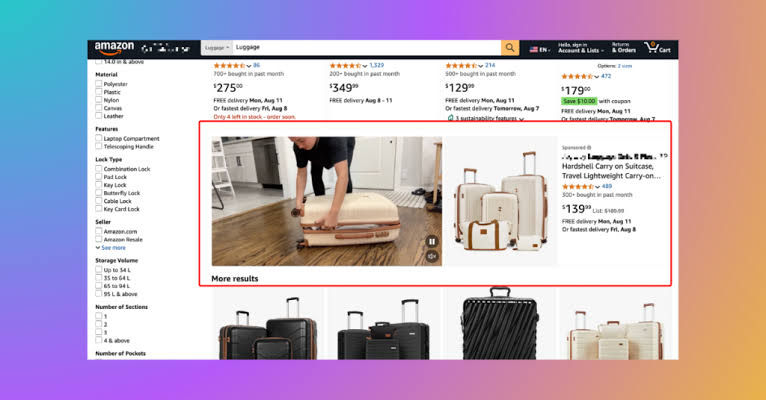
Sponsored Products are the core driver of Amazon sales. They place your listings natively within search results and directly on competitor product pages.
Launch an Automatic Discovery Campaign:
Create a Sponsored Products campaign in the Campaign Manager and select Automatic Targeting. Set a modest daily budget. Let the algorithm decide where to display your ad based on your listing SEO. Let this run for at least 14 days to buy data on how real shoppers search for your product.
Mine the Search Term Report:
Download your Search Term Report. You need to see the exact queries and competitor products that resulted in actual sales.
Launch a Manual Exact Match Campaign:
This is where the profit is made. Take the highest converting keywords from your Automatic campaign and move them into a new Manual Targeting campaign using Exact Match. Because you know these terms drive revenue, you can safely bid higher on them to capture more market share.
Target Competitor Pages:
Use Product Targeting in your Manual campaign to bid on specific competitor ASINs. If a competitor has a more expensive product or worse reviews, your ad will appear right beneath their bullet points. This allows you to steal their sale at the last second.
Step 3: Optimization & Advanced Ad Strategies
(This great walkthrough visually breaks down how to implement Amazon PPC strategies and optimize your campaigns step by step.)
The Amazon marketplace has matured. Simply turning on campaigns is no longer enough. Cost per click rates continue to rise. Profitability requires surgical precision.
Here are some advanced strategies to optimize your ad spend and scale effectively.
Optimize for TACoS Not Just ACoS
Many sellers obsess over Advertising Cost of Sales. That only measures campaign efficiency. Your primary metric should be Total Advertising Cost of Sales. This divides your ad spend by your total organic and ad revenue. If your TACoS is falling while total revenue grows, your ads are successfully driving organic ranking. Never cut bids simply to lower ACoS if it hurts your overall organic sales velocity. If you're starting a new product launch double your bids.
Leverage Term Level Bids
Amazon now allows for individual search term bids within Exact Match Sponsored Products campaigns. Dive into your search term data. If the singular version of a keyword converts at 12 percent and the plural version converts at 4 percent, you can bid higher on the converting variant and drop the bid on the weaker one. This drastically reduces wasted spend.
Stack Placement and Audience Multipliers
Amazon allows you to dynamically increase your bids based on where the ad appears and who is looking at it. If your data shows that being in the first row of search results drives 80 percent of your sales, you can apply a multiplier strictly for Top of Search placements. You can also layer on custom audiences. Amazon combines these modifiers to ensure you win the absolute most valuable traffic.
Implement Hourly Bid Scheduling
Not all hours are created equal. Shoppers often click on ads during their morning commute but wait until the evening to actually make a purchase. Use hourly performance data to identify time blocks with high clicks but low conversions. Automatically reduce your bids by 30 to 50 percent during those dead zones. Reinvest that saved budget into your peak conversion hours.
Aggressive Negative Keyword Hygiene
The fastest way to improve your profit margin is not by finding new keywords. It is by blocking bad ones before they drain your budget. Prepopulate your campaigns with a seed list of irrelevant terms. Review your search term reports every Monday. Any search term that receives 10 to 15 clicks with zero orders should be immediately added as a Negative Exact match.

Nathan Finfrock
Founder - Finfrock Marketing
Nathan is the founder of Finfrock Marketing, where he transforms marketing efforts into measurable revenue growth. With over 18 years of experience, Nathan has architected high-impact campaigns for organizations ranging from 500k startups to $5B enterprises and global nonprofits. He specializes in multi-channel SEO strategies that bridge the gap between traditional tactics and the future of search, including Answer Engine Optimization (AEO) and Generative Engine Optimization (GEO).